
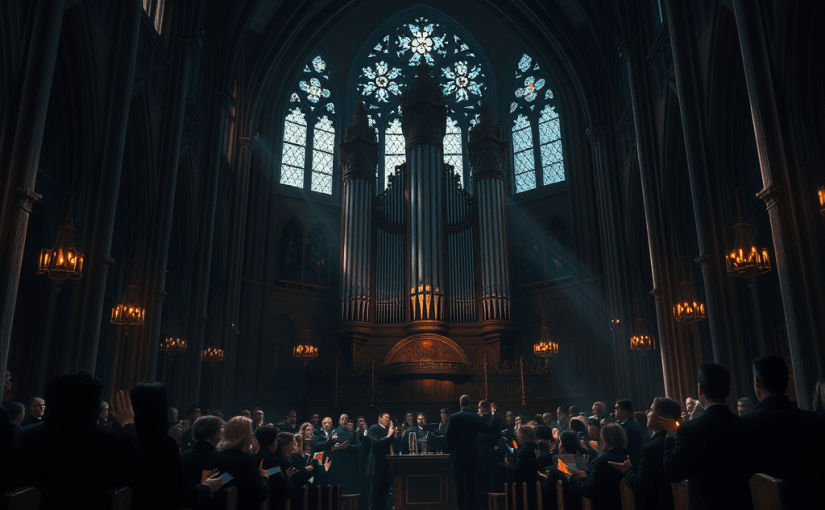
Every so often a thumping piece of music pops up on shuffle while I’m driving. Yesterday, it was the Gloria of Jean Langlais’ Messe Solennelle. I instantly turned up the volume and braced myself.
The Gloria forms the second main part of the sung Latin Mass. For most choral composers it offers a chance to produce a springy, upbeat melody in celebratory mood: a sequence of major chords and tunes which extol God in all his glory, with fulsome emphasis. ‘Laudamus te, benedicimus te, adoramus te, glorificamus te’, goes one early passage of the Latin text: we praise you, we bless you, we worship you, we glorify you. The mood of enthusiasm pulses through the words themselves; most composers recognise this by supplying happy, bright music to accompany them. This, is what you find in the Masses of Mozart, of Haydn, of Vaughan Williams, of Kodaly, of Beethoven – and many others besides.
Looking back into the annals of earlier choral music, music in a major key is at the heart of major earlier Masses by the greats of the 16th century: Palestrina, Vittoria, Byrd, Tallis. To sing ‘Glory to God in the highest, and peace on earth to men of good will’ is to chant happily, to eulogise, to make use of a lexicon which expresses the profoundest hope and optimism. A church service usually brightens, then, with a good Gloria.
This, at least, is the well-worn script. Langlais was the sort of rebel to tear it up. The French composer was richly but memorably described to me by a choirmaster at Winchester Cathedral more than 30 years ago: he was an eccentric genius, a brilliant and mercurial organist, quite blind, whose brilliance was thus all the more remarkable. Langlais, as he was described to me, was pre-eminent as an organist, a man to whom composition was very much a second string to his bow – though one at which he was plainly highly adept.
The Gloria in the Messe Solennelle is by turns electrifying, terrifying, dazzling, dark and moody – and exceptionally minor in its choice of key. To sing it, to listen to it, to be struck by it is immediately to be put in mind of the grandeur, the awesomeness, the immensity of a God who expresses himself in surprising ways. Excerpts of sonorous organ answer the choir. The noise of both choir and organ is… loud. There is an urgency to the melody. The different vocal parts burst into song in fugue-like succession. Langlais conveys a sense of glory which cannot be contained, cannot be simplified, cannot be captured neatly. The genius of this dark Gloria lies in how it dares to use such heavy and decisive tones, and all in the minor. Langlais switches through different keys in rapid succession. Each new expression about God seems to require a new modality. Again the organ chimes in. The pace quickens. And then: ‘Miserere nobis’. Slower now. And quiet. Before there is a rebuild toward a magnificent finale. And then, out of nowhere, a stunning major chord for the final ‘Amen’. I recommend the recording below to others (with volume turned up!).
 ad astra per mundum