A new Latin Pitch

The time is fast approaching when my third form (year 9) pupils will have to make their options choices for GCSE. Since Latin is no longer front and centre of the school curriculum in the school at which I work (as it was once upon a time), this means Latin will be up on the market as one among several options the pupils will decide between. And, for me, this means it will be a case of making a pitch for Latin, as a subject, which will enable it to compete with such alternatives as Art, Computer Science, Geography, History, Music, Spanish and plenty more besides.

In past years, my pitch for the subject has tended to focus on its broad-ranging fascination – at GCSE you get to study not just language and words, but interesting stories, and plenty of Roman literature and culture. I emphasise that pupils seldom regret choosing Latin; that it is particularly suitable for the academically capable and ambitious; that it allows you to gain access to another world far-removed from our own (yet eerily familiar) in a way few other subjects will. It is, in short, a subject for life, not just the classroom. This has usually gone down well, even if it doesn’t necessarily convince some among the hardline utilitarian or ‘relevance-obsessed’ 13 year olds I sometimes come across. At my current school, with its backdrop of neoclassical architecture and its stunning gardens, replete with classically-themed temples, grottos and sculptures, the ‘relevance’ of the Classics hardly features as a topic for debate, since its presence all around us makes it an obvious source of fascination.

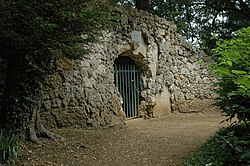
In fact, I have made a point of taking all 40 or so third formers on short walks out to Dido’s Cave and the Temple of Venus (at the edge of the gardens). I have done this partly to ensure that the school’s topography and architecture is very much on their minds as they make their options choices, and partly to dovetail with their initial explorations of the story of Virgil’s Aeneid, in which both Venus and Dido feature prominently.

But the ‘new’ Latin pitch I refer to in this blogpost’s title refers not to these walks, but to a bolder line of approach I have started to adopt in advertising the merits of the classical subjects (not just Latin but Greek also) to students. This pitch aims to address the underlying utilitarian concerns pupils bring into play when weighing up classical study.

It runs something like this: every day of your lives, in whatever line of work you end up going into, and in the context of whatever relationships you go on to form, you are going to be reliant, most likely, on the English language, its use and manipulation, and on your powers of expression. Don’t underestimate the importance of this. Your use of this language will establish the contours of your most valued relationships – with colleagues, friends, family members, and in affairs of the heart. Skill with language – and the ability to see through others’ words – will also allow you to escape the thoughts and linguistic tricks of others when they are being cruel or manipulative. Being able to use language skilfully will be vital, both for enjoyment and success.

What could give you a better grounding in your use of language than a thorough grounding in Greek and Latin? You may think that these languages are incidental to modern life, but the lie of that will become apparent if you just look closely at the words of that very phrase. The fact is that you are already speaking and thinking in Latin and Greek, much of the time, whether you know it or not. Wouldn’t it be ‘useful’ to get to know better this central feature of your ‘toolkit’ for life? To see what’s really going on in your use of words? To enjoy getting to know better how many of these words were used – in their original form – by their most skilled ancient users?

Perhaps this all sounds a tad melodramatic or intense. I had not been in the habit of pitching about the attractions of Latin in this way before the past few months. But as time passes, and as the newspapers carry more and more stories about the gradual and horrifying dawn of a post-literate society, it seems right to turn the focus of any pitch for Classics onto the centrality of words in our lives, their power to enrich us, their charm and magic.

Postmodernity has tended to frown on ‘logocentricity’ (one of its uglier jargonistic neologisms meaning a fixation on the written word as a means of conveying truth) while developing a desperately ugly and unapproachable form of academese. While I take the point that the written word is not, and could never be, the sole measure of truth and meaning, the flight from great writing, and from the ennobling use of language more generally, over recent decades is one Classics teachers are particularly well-placed to start speaking up against.

Toddlers and the Old Masters

Reading was nearly always my de facto leisure activity in the school (and university) holidays. The holidays have always represented a chance to escape deep into the pool of history and literature I have loved to soak myself in since childhood – and until recently only exceptional circumstances could change this.

Now, however, with three young children under the age of 7, I cannot count so readily on time to spare for my love of reading. Reading has to be squeezed in wherever possible; writing even more desperately so. As I type this, a 2 year old is trying to cover me with a blanket, while a 4 year olds is asking where she can find another biscuit. I break away from the screen to tell one to stop, the other that she can’t snack now as dinner will be ready soon. Back, now, to my screen.

As a tired parent of young children, I started early on to find that my capacity for sustained concentration on long sentences of text on page was substantially diminished. I would not – could not – turn to TV as a sort of substitute: I broke decisively with that medium as a vessel of entertainment way back in my early 20s. I still love movies – well, some – but TV I have for some time regarded as something like a cesspit in which I do not wish to spend any time. (As an aside, students I teach – who have often discovered this fact – question me with scrupulous zeal and disbelief when I reveal it; I do not know how successful are my attempts to convince them that life beyond TV is, in fact, rather worthwhile).

What medium, then, to seek when pages of text are too much to cope with after a long day, and the humdrum presentism of the TV screen seems too banal to contemplate? The answer, I have often found, lies in Art – and in my growing collection of Art books. It is a brilliantly relaxing activity to sit and take in great works of art, to glance across page after page of image and artistry, to be sucked into the worlds and scenes that great painters of the past have endeavoured to convey.

And, what’s more, this proves a very lovely opportunity for fun with toddlers (and older children too) – who love looking at the paintings, identifying what’s depicted, naming colours and characters they can spy. Earlier this evening my two year old flicked through 25 pages of Degas and 23 pages of Matisse (OK, not exactly an old master) with me and she delighted in much of what she saw, as did I. Not a bad way to relax after a day of work.

RG Collingwood on Writer’s Block

School holidays bring more than their usual fair share of activity for me these days, with a young family, a new house, and various admin jobs to complete over the break. So the usual habit of being able to slip away into the joys of reading and writing has had to take a back seat. Scrolling idly through twitter earlier in the summer break, I noticed a reference to RG Collingwood’s autobiography – a text I read many years ago now, and enjoyed.

As a graduate student, I had read several of Collingwood’s books, having been led to them by favourable references in the historian Quentin Skinner, whose writing I was also absorbing at that time. Anyway, coming across Collingwood again jolted me to revisit his autobiography, which tells the story of a figure who managed to rebel significantly against many of the leading ideas and orthodoxies of intellectual life in his time. And, luckily for him, to find some decent recognition and praise for doing so.

I have now reached chapter 5 of the autobiography and already several features of the text have jumped out and prompted reflection. Foremost among them: Collingwood notes how, so often in his own time, participants in major intellectual debates prefer to argue with caricature versions of their opponents’ positions, rather than reality. Collingwood reports on how it is easy enough to see where this is happening by simply looking up the arguments for oneself, and reading them, as set out, by their originators. This is a familiar feature of intellectual life, and indeed political life, in our own time.

Probably because of my own lack of productivity of late, I was struck also by Collingwood’s remarks in chapter 3 of the autobiography on ‘why people do not write books’. He knows, he says, of just two reasons: ‘either they are conscious that they have nothing to say, or they are conscious that they are unable to say it’. He adds: ‘if they give any other reason than these it is to throw dust in other people’s eyes or their own’.

Collingwood’s matter-of-fact plainspeak is refreshing at a time when fuzzy fake-warmth permeates so much of our written expression. The candour and precision of the judgment here reminds me of Orwell (among others). The passage made me wonder: in my recent inactivity, do I fall into one of these camps? If I tell myself I don’t, am I simply throwing dust into my eyes?

Having considered the question, I want to argue with Collingwood that feeling rested and well is an important condition for the production of good writing. One might be conscious of having things to say, or indeed conscious that they are still ruminating about how best to say it, without yet being in a position to sit down and write.

So I suppose I dissent from his position, as articulated here. This said, it is equally the case, I find, that, like much else in life, writing is a habit, and if one falls out of a habit, it is hard to pick it back up. On this note, look out for more blogposts from me on here soon. The habit of contributing regularly to adastrapermundum is one I miss and hope to revive.