
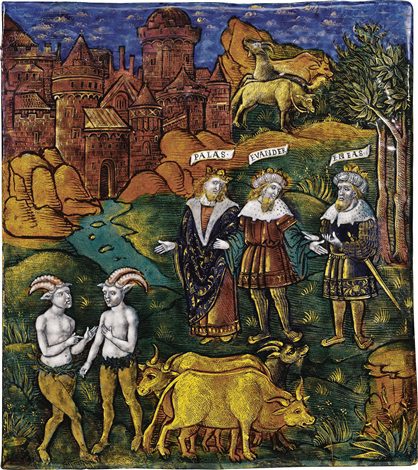
This Easter holiday, after a particularly intense term, I have been taking the opportunity to reread one of my favourite passages of ancient literature, book 8 of Virgil’s Aeneid, in Latin. The motivation for this came from reading a section of this text – the Hercules and Cacus episode – this term with a GCSE Latin class. Our lessons focussed only on the chunks of Latin they have to cover for their GCSE: it has been a pleasure to revisit book 8 in full.
The book is full of memorable moments aside from the lines concerned with Hercules and Cacus: at the opening of the book, the scene with Tiberinus, god of the river Tiber, and the portent of the white sow; later, the meeting of Evander and Aeneas, and the tour around the site of future Rome; then the Venus/Vulcan episode; and finally Aeneas’ receipt of his amazing shield and the description of its appearance.
In book 8, Virgil brings into particularly clear focus the fact that he is interested in bringing together into the same narrative frame 3 distinct temporal phases in Roman and proto-Roman history: the mythical past (the time of Hercules), the heroic present (the time of Aeneas), the great future (the age of Augustus). Virgil wishes his readers to appreciate clear parallels and links – sometimes jarring – between these ages.
As I have reread the text, I have relied upon the Cambridge Green and Yellow commentary of K.W. Gransden, which just happens to be the first Latin commentary I ever used, when I was doing Latin A level myself. It is a superb commentary, and it has been a pleasure to read it again after all these years. And so the multiple temporal perspectives in Aeneid 8 have had a corresponding pattern in my own history of readership. As I reread the text (and Gransden’s commentary on it) in detail after a 20+ year hiatus, I am reminded not only of its richness but of the importance of bringing alive the sites and stories of antiquity – as Evander does for his Trojan visitors – for new readers.
 ad astra per mundum