amo… amamus?

A story about outmoded and severe prep school instruction pops up on my twitter feed. It puts me in mind of a few memories of my own, albeit nothing quite so severe. Here is one.

The year is 1993 (late) or 1994 (early). We have been learning Latin for over a year, having started in ‘B Block’ (aka year 6) the previous academic year. The first thing our eccentric and sharp-witted teacher has taught us is the present tense of the first conjugation verb, amo. In our first lesson, we have transcribed this precisely (and neatly) into our brand new Latin Grammar books (which we have been instructed to adorn with red tape on the front cover). We bring these books to each lesson.

The atmosphere in our classroom is always intense, with hardly a word out of place from pupils. We cover lots of stories, lots of grammar, and lots of vocabulary. I enjoyed the subject immensely and found it came to me pretty naturally. Probably the emphasis on precision, the clarity of delivery, and the high standards in class helped a great deal. When I left the school aged 13 I realised I was ahead of schedule on the way to Latin GCSE.

My experience is not shared by everyone. One boy in the class, in our second year of study, is struggling with a passage of unseen translation. He is mistranslating a present tense verb. Our teacher tries to send him back to fundamentals. ‘What did we learn in our first week of Latin?’ he asks him. ‘Conjugate amo!’ The poor pupil grudgingly attempts to oblige. The subject has not come naturally to him at all, nor – I guess – has he worked on it much. ‘amo…. [long pause]…. amamus?’ The second word is said in an unsure, questioning tone, of the sort this teacher despises. He expects you to know your stuff or to admit you don’t (and say so).

Chaos ensues. Teacher snaps pencil and leaps up from his chair. Chair flies backward, tipping onto the floor. Teacher storms round the room, passing all our desks, making his way all the way to the door to the classroom. With enormous energy, he takes hold of the classroom door, and slams it shut, full force.

Most of us pupils have been trying to avoid eye contact, knowing that any small titter could set the whole room off. But the high drama of the moment has intensified further. Just as our teacher reaches the door (issuing a flow of condemnatory phrases as he makes his way there), we become conscious that some people have appeared in the corridor just outside the door. It is the Headmaster and some prospective parents. The full force of the door’s slam is delivered at precisely the moment the Head turns to enter the room. Comedy blends instantly with tragedy: terror about what could now unfold grips the room. Could we somehow be held responsible for this moment of absurdity?

There is a pause. After 20 seconds or so, the Head opens the door, fixing the teacher with a hard stare, while attempting to make some smalltalk about Latin in the school. We boys fix our stares into our books, trying desperately to avoid eye contact with each other or anyone else. I sneak a look up: the visiting parents look embarrassed. Somehow a minute or two passes, and the Head finally leaves.

The whole scene had been too perfect. The snapped pencil, the slammed door, the Head’s untimely arrival. We talk about it for months afterwards, as most 11 year olds would. As for the first conjugation verb, I’m not sure the pupil in question ever managed to master it.

And as for audeo being semi-deponent, it was cheering to note that some posters on twitter pointed out that some speakers of Latin did not treat it as such. Sometimes real Latin was not as precise as the modern grammar books would have us believe.
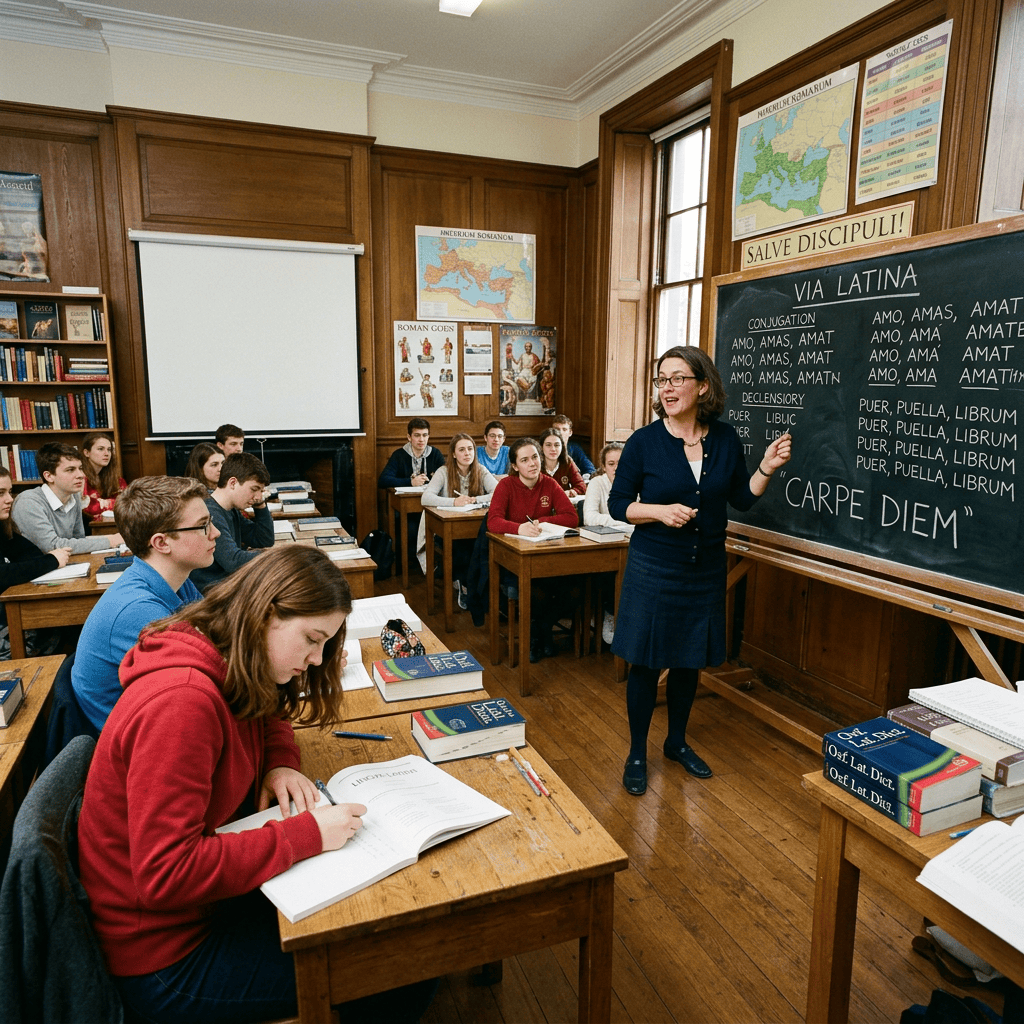
Teacher teaching Latin grammar with conjugations on a chalkboard
A teacher leads students through Latin grammar in a historic wood-paneled classroom.

Mrs Hall and Mr Smith

Armand D’Angour published an interesting short post yesterday (link here) on the topic of education. The post touched on a couple of points which ring familiar and true – the sense that some pupils (the very best, at any rate) don’t require a great deal of instruction; the notion that the best sort of education involves the (successful) cultivation of habits of mind, rather than the imparting of specific information.

The first point clashes with some of the familiar depictions of education in popular culture: as Armand writes, ‘popular films like Dead Poets’ Society, The History Boys, and most recently The Holdovers present the experiences of schoolteacher and students, emphasising the effect of instructors (inspiring or otherwise) on young minds’. In some of these settings, educators are depicted as heroes, as figures of inspiration, who command the wonder of their students. This is something, perhaps, which good teachers might consciously guard against.

That they should is something which is explicitly flagged, for instance, by one of the great pioneers of girls’ education in the Victorian period – Frances Mary Buss. Although she aimed to have an energising impact on her pupils, Buss was entirely opposed to ‘hero-worship’ (something she thought might nevertheless happen naturally enough in children). To this end she offered the following common sense advice to a young teacher who was struggling to deal with being idolised by a pupil: ‘the quickest way to stop that sort of behaviour’, she counselled, ‘is to let the girls get to know you. Once they see you as you really are, they will stop idolising you’. Pupils don’t need idols, one might surmise. What they do benefit from, though, is real life, down-to-earth role models who can help them imagine themselves into the adult world.

The sense that, as an educator, you are providing not just an academic training but a training in what it is (and might soon be, for pupils) to live as an adult was something that struck me powerfully (and that surprised me) when I first started working in schools. The ‘socialising’ role of the educator had been something I had more or less overlooked. Perhaps I had been entirely taken in by the utilitarian spirit of our age, in that my governing assumption had been that teachers – and lecturers – are there to impart skills and information. I had not given much thought to the question how, if at all, they might accomplish these tasks in a way much dissimilar from how a robot might.

As the years have gone by, I have become a bit more reflective. I have thought a lot – in particular – about some of my own teachers. Most recently, I have thought especially about two of my Sixth Form teachers – Gill Hall, who was Head of Classics at my school as well as my Sixth Form tutor, and Rupert Smith, who came in to replace her when she was diagnosed with (what turned out to be terminal) cancer. My mind has turned to these figures precisely because of the tragedies they both faced when I knew them in the classroom – and of how, in each case, their handling of this provided a certain sort of quiet inspiration.

It cannot have been at all easy, in Mrs Hall’s case, to come in to teach a full timetable of classes when facing a serious cancer diagnosis. The summer before she stopped teaching our Latin class, she was busy happily commending to our small A level set the pleasures and rewards of studying Classics at university. I was particularly moved that she saw potential in me that year, as I had notably underperformed in our summer exams across the board, having succumbed to the temptations of football, football and more football outside school in the weeks before the exam. I had given my teachers very little evidence that I was a high calibre student. Mrs Hall nonetheless thrust a copy of an Oxford prospectus into my hand, and even signed me up for an open day at the college she herself had attended, while telling me that I had the makings of a good Classicist. She had seen something in me that I had not seen in myself. And she was, without doubt, the only teacher who showed any optimism whatsoever about my academic potential that summer. That faith galvanised me – and I worked very hard over the next year (and beyond) to try to repay it. Alas, though, her illness worsened, and she tragically passed away later that very year at a terribly young age. It was an awful loss for all who knew her. I remember being speechless with grief and shock on hearing the news. Because of her untimely passing, I was never able to thank her for her belief in me at a particularly low academic ebb. But I have thought often of our interactions that summer – and of how, in the midst of what was certainly a time of increasingly acute suffering for her, she was still looking to bring the best out of others, including me – and to show faith in the potential of those who might not deserve it all that much.

When Mr Smith came in to replace Mrs Hall the following term, he immediately struck a chord. Immaculately turned out, with a polished and polite demeanour, he came across more as country gent than seasoned classroom practitioner. I still remember his brown suede boots: I had not seen another teacher in our ex-grammar wear shoes like those. Mr Smith was a part-time fixed term appointment, and I knew nothing about the circumstances of his being at the school – save one: he was now the sole parent of a young daughter, as he had recently lost his wife. Mr Smith’s job was to teach us to translate Latin prose authors – especially Caesar – and he did it with a smooth confidence and gentleness. He was utterly unflappable, in fact, and when the typical mischief of missed or incomplete homework surfaced in our lessons, he was smilingly pragmatic about what to do about it. I believe he went on to work at a nearby school in Winchester, and I heard reports of his being much loved there.

I have thought a lot about Mrs Hall and Mr Smith – their bravery, their devotion to their subject, their smiles in the classroom even in times of horrific adversity – in recent months. Both of them have been with me as silent companions as I have taught my own classes at a time of grave personal loss and turmoil. They are not ‘heroes’ in the sense of being awe-inspiring educational gurus, though both were excellent teachers – but as quiet yet resplendent role models for their humanity.

In a noisy and often rather shallow world, where ‘impacts’ and ‘objective measures’ are the order for the day in educational settings, it is the unmeasurable humanity of real teachers, simply acting as good human beings in (for instance) their handling of adversity, moving ahead with their lives in spite of the presence of darkness, which can give a sense of what can matter most in an educational encounter. The best schools, I think, know this, and know that they have to try to fill their classrooms with the likes of Mrs Hall and Mr Smith.