A new Latin Pitch

The time is fast approaching when my third form (year 9) pupils will have to make their options choices for GCSE. Since Latin is no longer front and centre of the school curriculum in the school at which I work (as it was once upon a time), this means Latin will be up on the market as one among several options the pupils will decide between. And, for me, this means it will be a case of making a pitch for Latin, as a subject, which will enable it to compete with such alternatives as Art, Computer Science, Geography, History, Music, Spanish and plenty more besides.

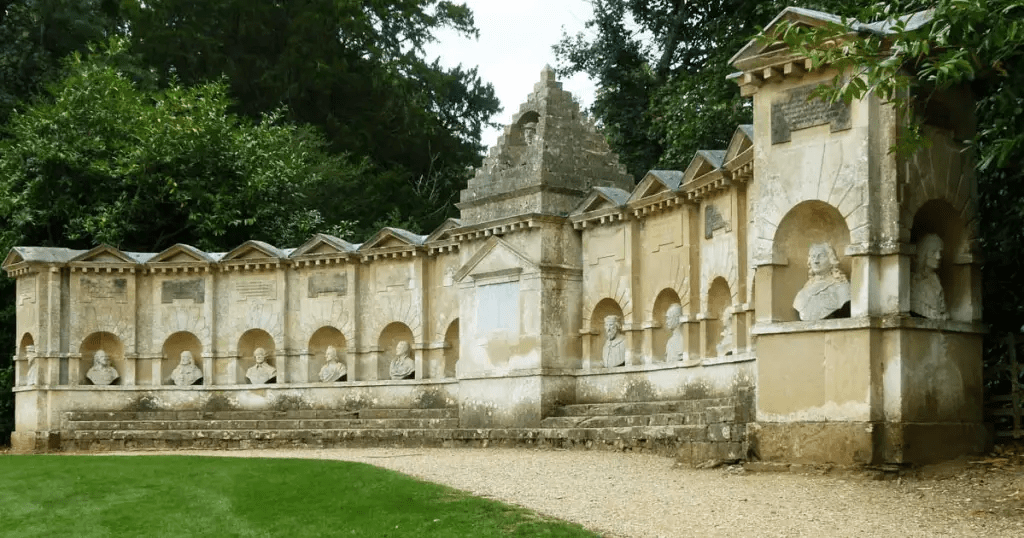
In past years, my pitch for the subject has tended to focus on its broad-ranging fascination – at GCSE you get to study not just language and words, but interesting stories, and plenty of Roman literature and culture. I emphasise that pupils seldom regret choosing Latin; that it is particularly suitable for the academically capable and ambitious; that it allows you to gain access to another world far-removed from our own (yet eerily familiar) in a way few other subjects will. It is, in short, a subject for life, not just the classroom. This has usually gone down well, even if it doesn’t necessarily convince some among the hardline utilitarian or ‘relevance-obsessed’ 13 year olds I sometimes come across. At my current school, with its backdrop of neoclassical architecture and its stunning gardens, replete with classically-themed temples, grottos and sculptures, the ‘relevance’ of the Classics hardly features as a topic for debate, since its presence all around us makes it an obvious source of fascination.
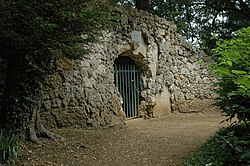
In fact, I have made a point of taking all 40 or so third formers on short walks out to Dido’s Cave and the Temple of Venus (at the edge of the gardens). I have done this partly to ensure that the school’s topography and architecture is very much on their minds as they make their options choices, and partly to dovetail with their initial explorations of the story of Virgil’s Aeneid, in which both Venus and Dido feature prominently.

But the ‘new’ Latin pitch I refer to in this blogpost’s title refers not to these walks, but to a bolder line of approach I have started to adopt in advertising the merits of the classical subjects (not just Latin but Greek also) to students. This pitch aims to address the underlying utilitarian concerns pupils bring into play when weighing up classical study.

It runs something like this: every day of your lives, in whatever line of work you end up going into, and in the context of whatever relationships you go on to form, you are going to be reliant, most likely, on the English language, its use and manipulation, and on your powers of expression. Don’t underestimate the importance of this. Your use of this language will establish the contours of your most valued relationships – with colleagues, friends, family members, and in affairs of the heart. Skill with language – and the ability to see through others’ words – will also allow you to escape the thoughts and linguistic tricks of others when they are being cruel or manipulative. Being able to use language skilfully will be vital, both for enjoyment and success.

What could give you a better grounding in your use of language than a thorough grounding in Greek and Latin? You may think that these languages are incidental to modern life, but the lie of that will become apparent if you just look closely at the words of that very phrase. The fact is that you are already speaking and thinking in Latin and Greek, much of the time, whether you know it or not. Wouldn’t it be ‘useful’ to get to know better this central feature of your ‘toolkit’ for life? To see what’s really going on in your use of words? To enjoy getting to know better how many of these words were used – in their original form – by their most skilled ancient users?

Perhaps this all sounds a tad melodramatic or intense. I had not been in the habit of pitching about the attractions of Latin in this way before the past few months. But as time passes, and as the newspapers carry more and more stories about the gradual and horrifying dawn of a post-literate society, it seems right to turn the focus of any pitch for Classics onto the centrality of words in our lives, their power to enrich us, their charm and magic.

Postmodernity has tended to frown on ‘logocentricity’ (one of its uglier jargonistic neologisms meaning a fixation on the written word as a means of conveying truth) while developing a desperately ugly and unapproachable form of academese. While I take the point that the written word is not, and could never be, the sole measure of truth and meaning, the flight from great writing, and from the ennobling use of language more generally, over recent decades is one Classics teachers are particularly well-placed to start speaking up against.

Greek Through Latin

As promised another post for the blog this summer – and further soon to come. This one broaches the subject of the Classics curriculum in my school in Buckinghamshire, where we offer Greek and Latin through GCSE and at A level. The school itself could not be a more natural (and stunning) environment for these subjects, grounded as it is amidst the most splendid classically inspired architecture, where the beauty and personality of ancient culture comes fascinatingly to life in all sorts of ways. Some pictures to illustrate below…

Nonetheless, numbers doing the subject in the school are not at an all time high, since we can no longer rely on the privilege – long ago lost – of being a compulsory subject. Now, Greek and Latin exist very much as an optional choice in the school curriculum, and this is the case from pupils’ first point of entry into the school at age 13. Gone, then, are the days, when a Richard Branson – one of the famous ex-pupils to attend the school – would face compulsory lessons in Greek and Latin as part of his curriculum. More on the changing face of schoolroom Classics and its place in the curriculum another time, no doubt.

My point in the present post is simply that a big aim of mine over the next year is going to be to inject life (and pupil numbers) into Classics at the school. To do this, I plan to tackle the issue of the year 9 curriculum: the first term of year 9 is the point where pupils choose whether they will continue with a classical subject up to GCSE. They need to have a great experience in that term, and to see that the subject(s) are for them. At present numbers are pretty low for Latin, but particularly so for Greek (only 2 or 3 per year). How, though, to fix this?

Well, two ideas. First, any plan to do so must reckon with the fact that pupils enter the school in year 9 with quite varied experiences of the language(s) from their previous schools. Some enter as complete beginners. Some enter having studied Latin (at least) for 3 or so years. So my plan is to create a two-tier experience for the pupils in the subject over my first year with them: for tier 1 pupils, offer a full introduction and grounding in the basics (tier 1 would include not just beginners but pupils who have studied the subject before); for tier 2 pupils, a compendium of additional translations and language work.

And this is where my second idea, which itself has two prongs, comes in: a) introducing them to Greek history/culture through Latin stories – and indeed b) to Greek language itself.

On a): the idea here is to use Latin as a basis to explore Greek stories and myths. Well, not exclusively Greek. What I really want to offer is a survey of some of the most interesting and absorbing short stories in Greek literature – from Herodotus to Thucydides to Xenophon to Homer and other poets. So there will be a booklet of stories which will allow just this. Pupils will build up a sense of how Greek writers tell fascinating stories – and would be even more fascinating to read in their own original language than in Latin. But starting by reading Greek stories in Latin is not a bad way to go. On b): pupils will have access to a basic Greek language booklet, which they can work through if they finish Latin tasks early in class.

On the basis of these experiences, I hope some will opt to take up Greek GCSE, in addition to Latin. We will see how it goes. The beauty of teaching Classics is that the material never fails to come alive: I am very much looking forward to reading lots of fun Greek stories (in Latin, at least initially) with my new pupils next term.

Translating Long Sentences in Latin Prose: Some Tips

As pupils begin to develop their fluency in Latin reading and unseen translation, and begin to dig into the writing of some of the trickier Roman prose authors who form part of their Sixth Form syllabuses, they start to have to translate long sentences. Usually they find this difficult. No other Latin sentence is as lengthy as the 279 words of the longest sentence we have on record in Classical Latin (from Cicero’s De Oratore, 202-5), but many sentences in e.g. Livy do stretch on, covering several lines of a modern edition.

Short Latin sentences can often be read fluently and without much pause for thought. Long sentences, however, often require thorough and painstaking treatment. Breaking them down into their essential elements is wise, especially when you’re making your first attempts at dealing with them.

Here below I offer 5 (now 8 – after an edit) small suggestions on how to tackle the task of translating longer prose sentences when you’re first starting out. The suggestions are intended chiefly for my students – but maybe others will also find them useful. I would be very happy for others to add further suggestions in the comments!

  1. Use every clue the modern editor of your text offers you in the form of commas and inverted commas. Commas often separate off clauses from one another and this can enable you to break down a long sentence into smaller units of meaning which you can treat independently. Watch out, however: bad editing of a text may involve the insertion of commas in unhelpful locations (a rare, but not entirely unheard of, problem) and this can generate entirely avoidable confusion.
  2. Use conjunctions to your advantage. Conjunctions do important work in long sentences; they can help you break it down, especially if they separate off clauses from one another or indicate that a new main verb has taken over the action. It is often helpful, therefore, to underline conjunctions as you aim to think about the sort of work they’re doing where they appear in long sentences.
  3. Find all/any main verbs in a sentence, underline them, and work out whether they’re part of a subordinate clause (e.g. a relative clause), or part of the main clause.
  4. Locate any ablative absolutes and ensure you deal with them as discrete elements in your translation.
  5. Underline any vocabulary you’re unsure of or do not know. Build your translation up with a clear sense of what the ‘known unknowns’ (in the form of these words you do not know) look like. Having built up your picture of the rest of the sentence, try to parse/identify anything you can about words you don’t know, so that you can make a best possible educated guess at a successful translation when the time comes to do so.
  6. If there really is no way to make the sentence ‘work’ in English, try adding additional punctuation of your own – such as commas, or – if desperate, semi-colons or colons.
  7. Watch out for indirect statements which continue over several lines and/or beyond a colon. They can rely on just one opening verb, but be spun out across several infinitives which may appear on the far side of a colon! You will of course need to supply a ‘that’ when dealing with these.
  8. Once you’ve finished your translation, make sure that it makes sense in English. It is easy to lose sight of what a long sentence is saying when you’re working hard at translating it. If necessary, finesse phrasing in order to smooth any rough edges.

The Other Languages of Ancient Italy

Below is the text of an article I recently wrote for our school languages magazine. Much of the factual content of the article is based on reading I did in the OCD (Oxford Classical Dictionary), and it may be that certain sentences feature a misunderstanding or two, since I am no expert philologist. Nonetheless I thought readers of this blog might enjoy reading it.

Greek and Latin are today the best-known languages of ancient Europe – and there are good reasons for this. First, the speakers of these two languages produced literature and inscriptions which survive to us in large quantities far exceeding what we possess from most other ancient linguistic traditions; second, both languages were widely used, not just in a narrow geographical zone, but throughout the ancient Mediterranean, over many centuries; and third – both languages have enjoyed an amazing afterlife. They form a big part of the basis of the most commonly-spoken European languages today (English, French, Italian, Romanian, Spanish etc). And, equally crucially, the culture and literature of the original speakers of Latin and Greek have exercised a dramatic and influential impact on subsequent literary and cultural history.

The prominence of Latin and Greek is a reminder of how language connects with power. It was early Greek colonisation, and the later empire of Alexander the Great, which successfully spread the ancient Greek language across the ancient Mediterranean and beyond. And it was Roman military conquest which resulted in the spread of the Latin language – first, as Rome conquered Italy, throughout the Italian peninsula; later, as Rome expanded her borders, throughout the ancient Mediterranean, into France, Spain, North Africa, and beyond – even to that far corner of the empire, Britain. Latin and Greek, then, are languages of empire, not just literature and culture – and their ancient (and modern) prominence reflects this.

In spite of this background, I often pause to wonder, as a teacher of Classics, about the other languages of the ancient world – the ones we know less about; the ones we hardly know at all; the ones of which no trace whatsoever survives. In particular, since much of my day is consumed with the Romans and their Latin language, I find myself wondering about the other languages of ancient Italy.

As the Romans spread from their home city of Rome to complete their conquest of Italy in the late centuries BC, they inevitably brought their own language (Latin) along with them into the areas they conquered. It is clear enough that Latin became quickly established throughout Italy as a language of politics, diplomacy and trade. But what happened then to the languages of the conquered peoples? One broadbrush comment we can make here is that these other languages continued to be used. They did not just vanish once Latin appeared on the scene. But what broad features of the languages and their use can we identify beyond this?

To start off with, we must register that we can say almost nothing at all about many of the languages in question. Of Paelignian, Marrucinian, Volscian, Marsian and Aequian, for example, all languages of ancient Italy, we know almost nothing beyond the fact that they existed and were spoken. About other languages we can say more than this. Take the closely related languages of Oscan and Umbrian, both of which were spoken in southern Italy.

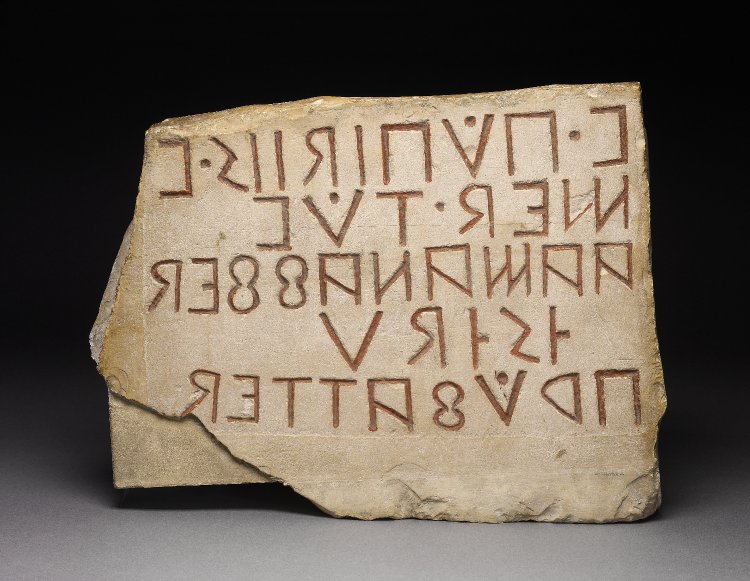
Umbrian is known chiefly from a collection of bronze tablets which survive from the 2nd century BC and from a collection of short inscriptions from c. 400 BC. As with Umbrian, our best evidence for Oscan comes from an early period (pre-Roman conquest). Oscan was clearly widely spoken in South Italy. It was the language of the Samnites, the tribe who took over the region of Campania in the 5th century BC. The Romans called speakers of Oscan ‘Sabelli’. The Oscan alphabet is known to us: there are coin legends, building inscriptions, texts painted on walls at Pompeii, curses, funerary inscriptions and more. Users of Oscan were not afraid to use the language flexibly: we have evidence of its being transcribed into the Greek, and later the Latin, alphabets, for example. In terms of their linguistic relationship, Oscan and Umbrian have a close relationship to one another, moreover.

Another important language of ancient Italy was Greek. Greek colonies were established very early in ancient Italy and down into Sicily – and the Greek language found a home in these settlements. The geographical zone in which Greek was used has been known as ‘Magna Graecia’ (‘Great Greece’!). One impact of the use of Greek in this area is the drift of Greek loanwords into other Italian languages – including Latin. Greek continued to be an important language in Italy after the Romans conquered the peninsula. For example, when St Paul addressed a community of Christians in Rome itself in the first century AD in a text which came to form part of the New Testament, he wrote to them in Greek. And Greek remained an important language for Christianity at Rome.

Fleeting glimpses of other noteworthy ancient languages appear in our evidence. A form of the Celtic language known as Lepontic was also used in ancient Italy, for instance: inscriptions found in North West Italy give evidence of its presence. Meanwhile, down in Sicily, we have evidence of the use of the important North African language Punic.

The Etruscans, and their Etruscan language, represent a major topic in their own right. Our historical record is patchy but it seems the Etruscans flourished especially as a major power across Italy in the 8th and 7th centuries BC. Inevitably their political strength is reflected in the spread of their language. The Etruscan language is interesting especially because it seems to have almost no obvious linguistic relationship to other languages we know about. This has made it particularly challenging for historians to decode the 9000 or so surviving Etruscan inscriptions, most of which are found in Etruria in central Italy.

There is something haunting about considering the use of these ancient languages. Once at the heartbeat of their respective towns, cities and societies, they are now known to us only dimly through small scattered evidence. Yet their traces remind us of the remorseless sweep of history, and of the fact that, in time, even the languages of great powers – such as Etruria, or Rome herself, or – dare we say it? – of the great powers of 21st century modernity – disappear or develop into something new.

Further Reading: The Oxford Classical Dictionary – articles on ‘Languages of Italy’, ‘Oscan’, ‘Sabellian’, ‘Etruscan Language’.

Consuetudo loquendi est in motu

‘Our manner of speech is in flux’: these are the words of Varro, the first century BC Roman encyclopaedist, as mediated through my slightly loose translation. Varro wasn’t thinking of individuals’ use of language when he wrote this – though, no doubt, his is a point that applies over the course of the life of an individual, just as it does over the course of a language’s life. Instead, he was participating in a highly self-aware Roman discussion about the developing use of the Latin language.

For many people who know some Latin today, it is easy enough to imagine the language as an impressively logical system – of clearly defined grammatical tables, of distinct word endings, and (more generally) of order and rational control. This image of the Latin language is in significant measure a product of the habits of teaching and learning favoured by 19th century educators: hefty Victorian grammatical textbooks are just one tangible artefact of their influence.

What I hadn’t really been aware of before this week was how the Romans themselves imposed considerable (conscious) control over the nature and structure of their language. This comes through in a range of first century BC discussions – in authors like Varro, Cicero and indeed Julius Caesar – of which I’m now aware. And it reflects an older Roman (and Greek) tradition of thinking about language use.

My education in this area has come about through reading Andrew Wallace-Hadrill’s Rome’s Cultural Revolution, a text I’ve had on my shelf for several years but which I’ve only just found the time to get into.

51aW7M2vRGL._SX348_BO1,204,203,200_

Romans of the first century BC were sometimes acutely conscious of linguistic differences in the way Latin was spoken (and written). Just as modern English speakers can effortlessly spot the differences between regional accents, national accents, formal and informal speech (etc), so too ancient Latin users would have spotted similar differences. But what were the boundaries of correct usage in amongst the (perfectly natural) linguistic variety that could be observed?

This is a question, Wallace-Hadrill suggests, that assumes an importance only with Rome’s – and Latin’s – imperial extension in the first century BC: ‘hand in hand with an insistence that others use one’s language is the establishment of authoritative standards by which to lay down what that language is’.

For Cicero, writing in his Brutus on the history of oratory, there was a pure use of Latin which all good orators – and indeed all good speakers of the language – should aim to practise. There was a time, Cicero thinks, when all Romans would speak this pure form of the language as a matter of custom. So what changed? A flood of people of diverse origins, he explains, has entered Rome. They have tainted the language, polluting its proper use!

LCL342

Cicero’s explanation is strikingly reductive (and prejudiced!) – but it is interesting that he seems to assume that ‘proper’ Latin was only ever spoken at Rome (and that non-Romans were never in command of pure Latinitas). Wallace-Hadrill makes short work of Cicero’s argument, pointing out the myth of ‘purism’ while noting also that ‘purism’ can only be imposed on a language by the imposition of an external authority (e.g. a grammarian!).

Varro, unlike Cicero, was a realist about linguistic change, just as he was about other changes of custom. Old practices can give way to new ones in clothing, building and furniture. Traditional usage in these and other areas has been replaced. The same is true for words. Consuetudo – custom, then (whether linguistic or otherwise), can itself be remade: it is not forever set in stone, as a Cicero might have preferred.

By the end of the first century BC, the power to define consuetudo, when it came to language, seems to have begun to move away from influential patrician figures like Cicero and Varro, who had previously been the key voices in its constitution. From this point, upper class influence on correct Latin usage was no longer to have quite the weight it once did: instead the foremost authorities when it came to defining what was ‘correct’ Latin would soon be professional grammarians. This is an area about which I have more reading to do.

Sewers and Octopodes

In these difficult times, I’ve found there are worse ways to maintain spirits than trying to remember fun moments in the classroom over the past term. It’s disarming to think that teachers could by now have had their last lessons in person with the pupils they’ve taught during the current academic year. Well, below, I’ve tried to record a fun portion of one of my lessons, in which discussion ranged widely – across food and drink, sea creatures, grain supply and Roman sanitation.

My year 7 class and I had been talking briefly about Roman food and drink, and about the grain-heavy diets that many ordinary Romans had. The class had recently learned about garum – Roman fish sauce – and about the Roman fondness for wine, olive oil and various other foods and tipples. We’d had a little help along the way from an amusing episode of the series, ‘What the Romans did for us’, by Adam Hart-Davis.

Garum-2
Images illustrating the preparation of garum (Roman fish sauce), which seems often to have been added to desserts!

‘But what about delicacies?’ someone asked. Good question – so we started a discussion about the sorts of meats and seafoods that ancient Romans might (more occasionally) have eaten.

‘Octopus?’ suggested one class member. Probably not for most people, most of the time, I answered! But I do have a question for you about the octopus. ‘What is its plural?’

‘Octopi!’ This was the answer most of the group felt pretty confident with – especially since they’ve done a good job of learning their 2nd declension Latin noun endings (which have a -us ending in the nominative singular and an -i ending in the nominative plural). But a small smattering of class members tentatively suggested ‘octopuses’: octopi wasn’t the only pick.

EGWluwtW4AAyeWj
An octopus – aka polypus – on a Roman mosaic

Well, I asked, what if neither of those options is strictly accurate? Accurate, that is, if we treat ‘octopus’ as an ancient word. Confused looks.

Good, I said: this can be a little topic for you to do some research on later. Is there an additional possible plural of ‘octopus’ – and what might it be, and why?

The answer, jubilantly reported by some of the pupils in their next lesson, is that because of the Greek (not Latin) roots of octopus, the plural might best be given as octopodes.

They’d done well. Octopus does indeed have Greek roots – but, so it appears, the word doesn’t actually have an ancient provenance. Greeks certainly knew about the cephalopod we call the octopus, but the name they used for this animal was polypous (i.e. many footed creature). It was this word that Romans borrowed to give the Latin word polypus…and this is the word they used to designate the creature we know as the octopus.

It was only much later – in the 16th century. according to our best information – that the word octopus itself starts to appear for the first time, and it appears then in the English language. A nice discussion of this development is available here.

Roman-Ports-Boat-Grain
A depiction of a Roman grain transporter ship being loaded

From our rather inconclusive discussion of the octopus (how should you talk about more than one of them?) we turned to start talking about a separate topic relating to Roman diet: the Roman grain supply. This was crucial for Rome’s development and stature as a city during the high period of its empire. In order to feed the vast majority of the city’s inhabitants, emperors would import huge quantities of grain, all the way across the Mediterranean, from North Africa, for ordinary people to eat. It was given out as a hand-out.

Some of the class were shocked by this revelation. ‘Free food. Really?!’ Not exactly free, of course, but to the Roman plebs, it must have felt like it. This in turn set off a conversation about how modern governments don’t really do this sort of thing – and maybe it would be helpful if they did?

I asked the class to reflect on another key area of Roman urban life that they might find surprising: hygiene. Walking into the city of Rome in the 1st or 2nd century AD, I asked, what – perhaps more than anything else – might have imposed itself on your senses. One pupil saw immediately where I was going with this question: ‘the smell’, she said.

I remember reading a passage somewhere in one of Keith Hopkins’ books where he really insists on this point. The smell on the streets of the ancient city would have been ghastly, overpowering, horrific. City dwellers in the developed world today have no point of easy comparison.

But this, I told the class, brings us to another topic you may wish to do some research about: the Roman sanitation and sewage system (particularly the Cloaca Maxima). Despite the toxic stench of their city, the Romans possessed a remarkably advanced sanitation system, featuring underground tunnels and drainage. Without this, the city would surely have smelt a whole lot worse.

all-interno-della-cloaca
A modern view of the interior of the ancient Roman sanitation system, the Cloaca Maxima

I’ve noticed over the course of my time as a teacher that pupils in the 21st century classroom tend to assume that the story of historical development has been a pretty linear one of relentless progress: a sort of whiggish optimism, in other words, is pretty widespread. The history of Roman sanitation, of aqueducts and the provision of running water to urban centres, and of the Roman genius for engineering more generally, is a nice counterpoint here.

In these areas, Romans produced technologies that were not (in Europe, at least) to be matched for many centuries (over a milennium, in fact). With the demise of the Roman empire, some of the technology went out of use altogether, without being replaced by anything superior. Far from it. I’m sure my pupils now have a sense of this, even if they’re not exactly clear (as I myself am not) which word to choose if they want to talk about more than one octopus. Sometimes not even teachers have all the answers.

The Languages that made Latin

Yesterday’s lesson with my twelve year olds involved a few interesting moments. At one point, I found myself explaining to the class that the Latin language is not unlike other languages (including English) in that it had a number of ancestor languages out of which it developed. This seemed to surprise most, if not all, members of the class: I think their assumption had been that Latin was something like a primordial language, or, at least, one which somehow hadn’t been subject to a process of development of comparable complexity to modern English and Romance languages.

Correcting this misapprehension was one thing, but having done so I quickly ran up against some rather large grey areas (ok – gaps) in my own subject knowledge when I was asked to elaborate. ‘So which languages fed into Latin then?’ came the inevitable question.

My answer to this (in hindsight, pretty much inevitable, if entirely appropriate, question) started with a classic hedge, though one which I *think* does approximate justice to the state of research in the field: ‘Well, this is an interesting question and scholars aren’t *entirely* clear on it’, I began. I hope this is fair!

I then mumbled something about how we have only a quite incomplete picture of a number of languages which are close relatives of Latin – like Oscan and Umbrian – before mentioning that the linguistic relative of Latin that we know best is Ancient Greek and that Latin adopted a number of words from Greek. 

AN01188399_001_l
An inscription in Oscan

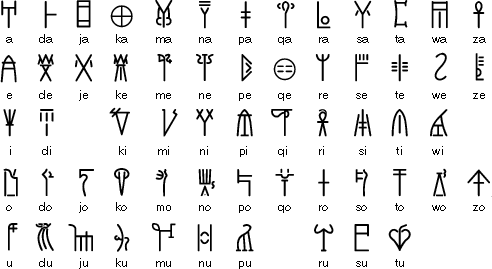
I then talked briefly (and, if truth be told, quite unconfidently) about Proto-Indo-European, the hypothetical ancestor language of Latin and a whole group of other ancient languages (including Greek), before mentioning Linear B as the oldest known linguistic relative of Latin that we have evidence of.

linearb
The Linear B script

So what did my mercifully brief and very scratchy attempt at philological exposition miss? Well, one obvious thing I didn’t mention at all is that the Latin language can itself be periodised and seen as a socially varied linguistic form. I think I am right in saying that classical philologists divide it (roughly) into early, middle and late forms** – and of course its character could vary profoundly depending on who was speaking it and where they were speaking. So an obvious example of what fed into Latin was, well, older, or socially varied forms of Latin itself.

Beyond this perhaps rather pedestrian-seeming (though important) point, there’s quite a lot more to say. And, from the cursory glance I’ve had tonight at a few pieces of research in this area, I realise my current knowledge-base is not even remotely close to where it would need to be to try to write any further with anything approaching conviction. So I’ve resolved to try to find time this summer to address this with some remedial reading (my intended purchase is James Clackson and Geoffrey Horrocks’ History of the Latin Language). More to come on this, perhaps, in a future post…

For the time being, I am going to present my 12 year olds with an extension task challenge: can they find any brief, interesting, accessible and reliable reading materials on the languages which influenced the development of Latin to share with their classmates (and me) to teach us all something new? I have no doubt that some of them are resourceful enough to succeed in this endeavour and I am looking forward to seeing their findings. This isn’t the first time a set of twelve year olds has led me to learn something new and it’s of course a teacher’s privilege that a good question from a pupil (however young) can help both fellow pupils *and teachers* find out new and interesting things.

*The featured image is of a Linear B inscription.

**I am referring here to Latin in antiquity, NOT to medieval and subsequent forms of the language.

The ‘cives’ of the Admiralty Arch

I have been doing some walking around the streets of London over the past few days, trying to keep an eye out for new things on some familiar routes. Maybe I hadn’t been paying much attention the last few times I’d passed it, but I noticed yesterday that the area surrounding the Admiralty Arch is under construction.

The arch is in a formidable location, just off Trafalgar Square at the entrance to the Mall (the thoroughfare specially designed for ceremonial parades going straight up toward Buckingham Palace). As an architectural monument, the arch is quite something. It is in fact comprised of three separate arches and a large building which straddles them (as pictured below).

IMG_0926

Constructed in the first decade of the twentieth century during the reign of Edward VII, the arch was designed by the prolific architect Sir Aston Webb. The arch was used for a long time as an office for the admiralty. My research tells me that under New Labour, it became a home for the Cabinet Office. In 2011, as part of the Conservative government’s public spending cuts under David Cameron, the Cabinet Office stopped using it and the arch was put up for sale on a 125 year lease.

The winning bidder – a Spanish real estate developer –  has begun the process of transforming the arch into a plush Waldorf Astoria hotel. It’s of course easy to understand why a property developer would want to snap up the arch: its views and prime location alone will no doubt make for a stunning hotel experience once it’s up and ready. And how many hotels can there be that are also architecturally imposing public monuments?

Perhaps the most characterful features of the arch are two matching sculptures – one of Navigation, one of Gunnery (pictured below: note the cannon in her lap) – which are built into its Mall-facing facade.

IMG_0931

What caught my attention as I walked past the arch, though, was its Latin inscription, which can be translated as follows: ‘In the tenth year of King Edward VII, for Queen Victoria, his most grateful citizens [built this arch] 1910’. A word features in the Latin of the inscription – ‘cives’ (citizens) – that surprised me.

For London’s inhabitants and for parliament, it had long been customary to speak of themselves as (royal) subjects, not citizens. It took twentieth century statutory developments, culminating in the British Nationality Act of 1981, effectively to supersede this custom. The fact that the arch’s inscription is in Latin, and the fact that Latin doesn’t have a neat translation for the English ‘subject’, explains why ‘cives’ was used on the arch. Since the time of Thomas Hobbes in the 17th century, it transpires, the English ‘subject’ had sometimes been translated to Latin using ‘civis’.* For this inscription, other alternatives could feasibly have been preferred, however: ‘populus’ (people), for instance.

What’s interesting to me is that the arch’s use of Latin – far from being a backward-looking feature – in fact anticipates a legal development (the widespread adoption of the language of citizenship) which only becomes enshrined in law decades later.

When shifting to a more thoroughgoing legal adoption of the language of citizenship in 1981, parliament effectively replaced a term – ‘subject’, which did not feature in the legal lexicon of the ancient world – with a central legal category of ancient Rome. This ancient Roman category represented a way to achieve a legal advance.

Do any other London monuments use the (Latin) language of citizenship in this same unwittingly prophetic way? I imagine some others must, though my internet searches have turned up nothing so far.

*Conal Condren, The Language of Politics in Seventeenth Century England, p.98f.